***LIVING BLOG POST: Hello all. I am VERY busy these days. Hence, a “living” blog post. Like all living documents, a “living blog post” is currently a Work in Progress, and can be added to and adjusted at any time, when time allows. In the case of this topic, I found myself absolutely deluged by the amount of work. I am steadily now trying to add sections as fast as I can. Thank you for your patience.***
THE SIMILARITIES BETWEEN THE SWORD OF SHANNARA AND THE LORD OF THE RINGS
Strangers from distant lands, friends of old, long has the tale been told that Terry Brooks’s 1977 fantasy novel The Sword of Shannara is a rip-off of J.R.R. Tolkien’s fantasy masterpiece The Lord of the Rings. In my own travels of the fantasy nerd-space, many a reader has made snide comments about the similarities found in the two works. And even though this assertion is common, I have never once in my life seen a definitive, point-by-point account of all of the similarities and references.
I will attempt to do that here. I’ve been a fan of both for some years, and have read both, and each a few times at that, and know each rather well. This, married with my love of story structure and granular deep dives, leads me to think I might have to be the one to do this. Like Frodo Baggins and Shea Ohmsford, I will stare down the arduous task before me and take up the quest!
Their journeys were long, and since I am attempting a thorough account, this will be as well. So be forewarned, dear reader, that this will blast beyond all blog post “recommended word counts” and be a very long piece. I will first go through the history of The Sword of Shannara‘s writing and publication, and then continue onto the comparisons between the two novels. I have decided this will best be achieved by going through the plotline of Sword and stopping to mention any similarities to Tolkien’s works along the way. We will stop very often.
A few disclaimers before we begin. Terry Brooks does know, as you’ll see in a moment, of these claims, and to use his own words, there is no criticism he hasn’t yet heard. Secondly, this piece is not meant to bag on Mr. Brooks. His books after Sword kept me up late many a night through high school and the intervening years and inspired my own writing of fantasy fiction. His 1982 novel, The Elfstones of Shannara, is one of my all-time favorites. He’s also delightful in person! So to reiterate, this is purely academic and literary criticism. So all good vibes to Terry Brooks. As he likes to sign in his books, “Magic Always!”
THE WRITING AND PUBLICATION OF THE SWORD OF SHANNARA
Sometime in the early 70’s, Terry Brooks submitted the manuscript for The Sword of Shannara to DAW Books’s Donald A. Wollheim. Seeing potential in the book, he suggested Terry send it to Judy-Lynn del Rey, who had just become the editor-in-chief of Ballantine Books’s science-fiction division. Judy-Lynn, being less familiar with fantasy, gave the manuscript to her husband Lester to read. In 1974, Terry would receive a letter from Lester, with the words: “Let me say at once that I consider your novel as potentially the best epic fantasy since Tolkien’s The Lord of the Rings.” More praise followed, and then a second letter arrived. This time, a 10-page letter of re-writes. “It was a substantial amount of work,” writes Terry in his memoir, Sometimes the Magic Works: Memoirs from a Writing Life, “but I did everything he asked without complaint because by then I would have walked barefoot over hot coals if that was what it would take to ally myself with someone who believed in me. I spent the entire next year working with Lester to improve the book. I rewrote sections repeatedly, and each time story became a little stronger.”
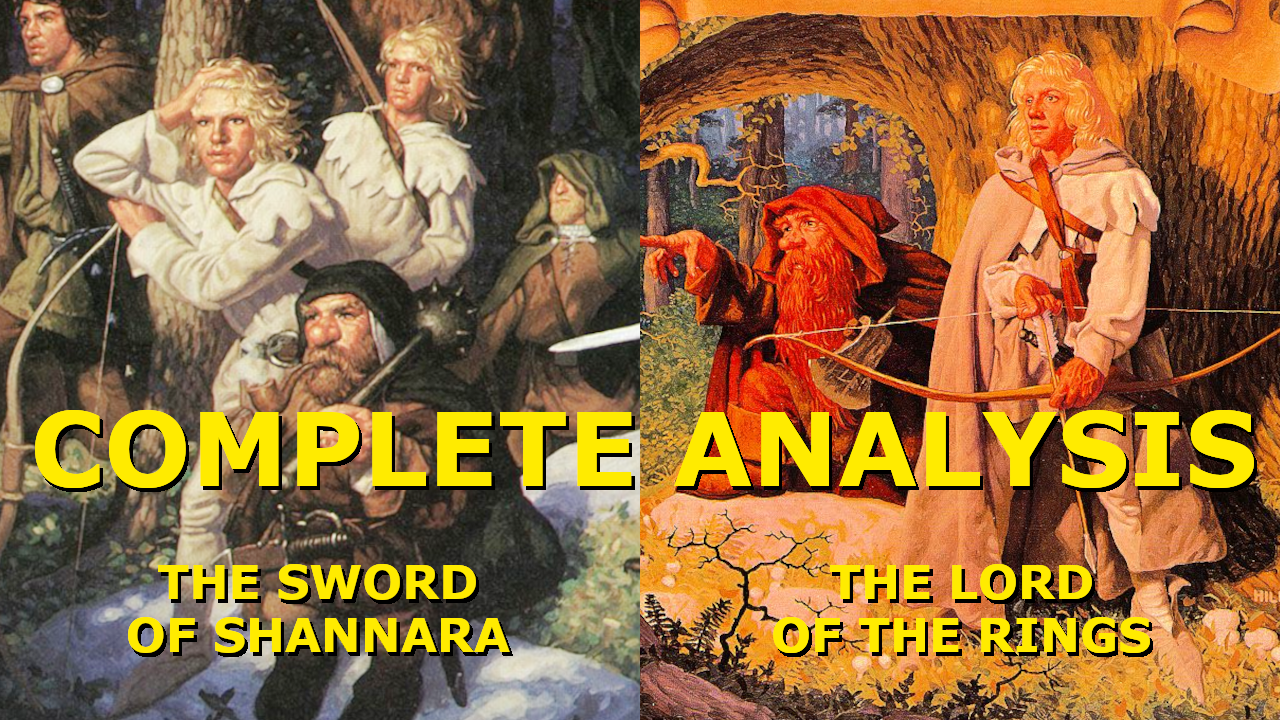
It’s important to note here that during this time, Lester was also the chief consultant on Ballantine’s Tolkien calendars, and oversaw the 1975 calendar (released in 1974). This calendar featured the artwork of twin brother Greg and Tim Hildebrandt, and sold very well. They would do artwork for the 1976 calendar (released in 1975), and the following year’s too (released in 1976). So who better to do the cover for the spiritual follow up, the heir ascendant, to LOTR? And who better, considering Lester knew them? Indeed! The Brothers would not only paint the cover for Sword, but also lend their talents to 7 interior pieces. If Lester thought Sword could be the next LOTR, then it might as well be marketed with similar imagery (or, er, the exact same imagery).
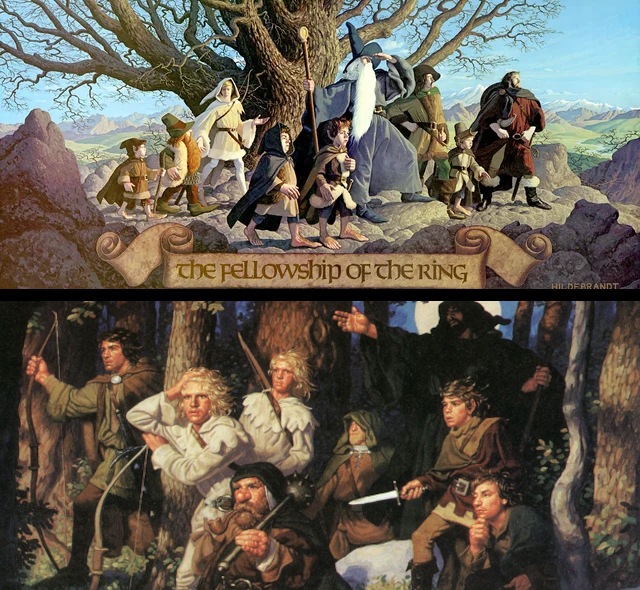
Sword was mentioned as LOTR‘s heir again in HEAVY METAL, issue 1, from April 1977: “Frank Herbert calls it ‘a marvelous fantasy trip’. Lester del Rey says it’s “very special in every way.’ Heavy Metal is proud to present the world premier [sic] – a preview of the epic fantasy which is predicted to be the biggest cult book since Tolkien.”
And so, the Sword, buttressed by Tolkien-esque art of the day and advertising gusto, was released in April 1977 (one month before another nerd behemoth, Star Wars. What a time). It sold incredibly well.
Throughout the years, comparisons to LOTR would abound. As I have before, Terry has known of these criticisms for years. Again, from Sometimes the Magic Works: “The work had been published precisely because it was so similar to Tolkien’s work, and for many critics and readers that was an unforgivable transgression. As a result, I was savaged in many corners.”
According to the Episode 64 of the Medieval Archives Podcast, released May 22, 2015, Terry said he had been “emulating Tolkien with a slight twist”, when discussing the writing his first trilogy: “No, you know, you write the first book and all you want to do is get your foot in the door. That’s all I wanted to do. I thought ‘I don’t know if this is good enough to get published.’ I didn’t know anything. I’m just out there emulating Tolkien with a slight twist on the whole thing.” You know, Del Rey [Lester’s imprint at Ballentine, long story] was excited about it, they liked it, and then of course it sold really well.”
Later, when talking about why his follow-up, The Elfstones of Shannara, was chosen for a television adaptation (that premiered on MTV in 2016), Brooks said: “One [reason] is that I felt that there was too much chance of criticism of the first book because of the Tolkien references. It’s very derivative in the first half, uh, it was a ‘first book’, y’know, I meant it was my ‘learner’ effort. I hadn’t written anything before that beyond just this and that. So I just felt that, y’know, we don’t need the hassle of having to defend ourselves because we’re using something that’s too Tolkien-esque.”
It is impossible to know just how similar Brooks’s novel was to LOTR before the year-long rewrites at Lester’s behest, but I thought it worth bringing up here. If Lester was looking to start his own imprint with Ballentine (he was, like I said, long story), and was looking for the next big thing, how much did he transform Sword? I am not alone in these speculations, as this blogger also alludes to this claim. Unless Terry tells us, we will never know.
All right. Sword is released and out. Everyone claims it’s a copy of LOTR. Let’s see just how close they are. Let’s begin!
THE PLOT OF THE SWORD OF SHANNARA
TRANQUIL HOMETOWN, ARRIVAL OF THE WIZARD, HISTORY, AND THE CALL TO ADVENTURE
Sword begins with young Valeman Flick Ohmsford walking through the wilderness, homeward bound. Upon the road, he encounters a tall, robed, forbidding man, who does not immediately tell him his name. Flick offers to show him to Shady Vale, Flick’s hometown, just the place the man was going. On the journey, the stranger urges Flick to duck into the bushes. Flick notices the man looking skyward, and there is nothing to be seen until a giant shadow clouds the stars. Flick is immediately filled with terror and dread. The shadow leaves, and the man suggests they continue. (We will circle back to this shadow later on).
Flick and the mysterious stranger make it to the Inn his father Curzad runs. His adoptive brother, Shea, is off on an errand somewhere. When Shea returns at the end of the chapter, the tall stranger, who calls himself Allanon, reveals he’s been looking for him specifically.
Chapter II commences and could be described as an exact mirror to Fellowship’s second chapter, “The Shadow of the Past”. This is where Gandalf explains to Frodo the history of The Ring, its connection to Sauron, Mordor, and the threat upon Middle-Earth. For Sword, through an infodump of the highest degree, Allanon tells the history of the Four Lands (Sword‘s setting), the multiple wars within them, and the biography of the evil Warlock Lord (ex-Druid Brona), who has risen again in the Northland after a defeat centuries past.
It is here Shea also learns about the talisman of the piece, the mighty Sword of Shannara, the weapon wielded by the legendary Elven King Jerle Shannara in the first wars against the Warlock Lord. To quote Allanon, “The Elves were led by the Druids and Jerle Shannara, who carried the great sword given him by [the Druid] Bremen. They fought together against the Troll armies, who were said to have had the added might of beings from the spirit world under the domination of the Warlock Lord. But the courage of the Elven King and the power of the fabulous sword overwhelmed the spirit creatures and destroyed them.”
After the Warlock Lord’s defeat, the Sword was placed in the Druid’s Keep, the tallest spire of Paranor, the Druids’ massive castle-like headquarters. As the prophecy states: “When the Warlock Lord appeared again in the Northland, a son of the House of Shannara would come forth to take up the Sword against him.” Shea is confused what all this talk has to do with him, but lo and behold, he is a distant blood-relative of Jerle Shannara!
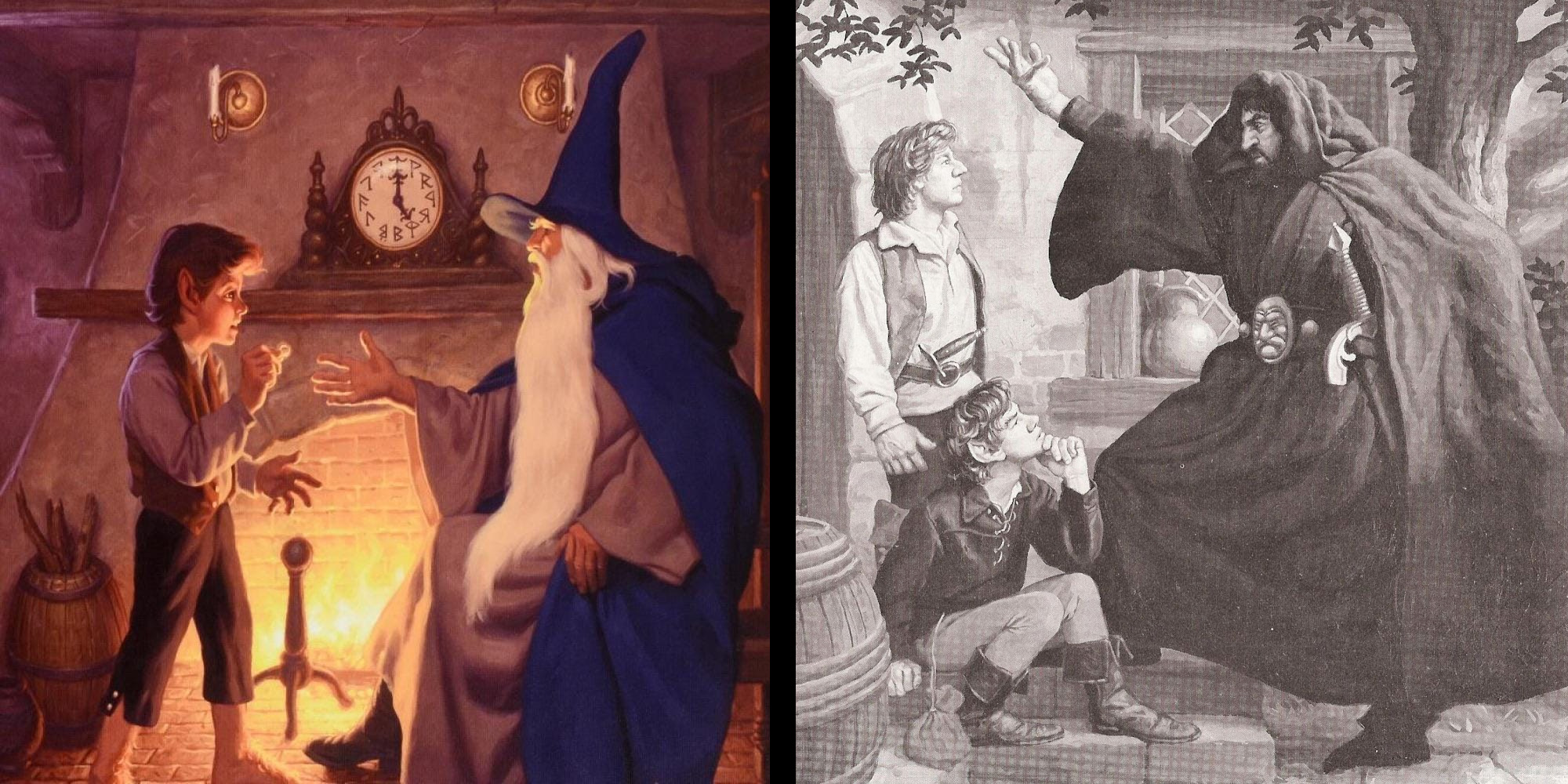
So far, the main setup of Sword and LOTR is strikingly similar. A long time ago, a Dark Lord threatened the world, was defeated, re-gathered his strength in silence, and is now returning. As Allanon describes: “Legends and myths that did not exist in yesterday’s world will exist in tomorrow’s. Things of evil, ruthless and cunning, after lying dormant for centuries, will now awaken. The shadow of the Warlock Lord begins to fall across the four lands.” The Warlock Lord is our Sauron. The Northland is our Mordor. Shea serves as our Frodo figure. His adoptive last name, “Ohmsford”, even features all the letters F-R-O-D-O within it. Is this coincidence or intentional? I will let you decide.
Allanon serves as our Gandalf. Historian, philosopher, magic-user. There are suspicions that Allanon is a magic-user early on, but it is clearly stated later in the novel when he says: “I am a Druid, the last to walk this earth. Like Bremen, like Brona before him, I have studied the black arts, and I am a sorcerer.”
Tom Shippey (Tolkien scholar grand master) would call Flick an analogue to three Hobbit companions, Samwise, Merry, and Pippin, in his book J.R.R. Tolkien: Author of the Century. I would more or less agree with assertion. That being said, loyal, faithful friends who go with you on a journey might just be part of adventure fiction. Still, I thought it worth mentioning.
Lastly, while the Shady Vale is not described much in detail, but is presented as a peaceful hamlet. “The path widened into a smoother dirt road that led straight into the hamlet, and Flick smiled gratefully at the lights that shone in friendly greeting through the windows of the silent buildings.” Is it an analogue to the Shire? Sure. Is it an archetype of a peaceful setting? Of course. Is it an exact rip-off the Shire? I would not make that claim.
ALLANON’S LETTER
Back to the narrative. The day after the history lesson, Shea and Flick find Allanon gone. He’s left a letter behind. I’ve put it here in it’s entirety, as it will introduce a lot of concepts familiar with Tolkien’s works:
“I have no time to find you and explain matters further. Something of the greatest importance has occurred, and I must leave immediately – perhaps now I am even too late. You must trust me and believe what I have told you, even though I will not be able to return to the valley.”
“You will not be long safe in the Shady Vale, and you must be prepared to flee quickly. Should your safety be threatened, you will find shelter at Culhaven in the forests of the Anar. I will send a friend to guide you. Place your trust in Balinor.
Speak with no one of our meeting. The danger to you is extreme. In the pocket of your maroon travel cloak, I have placed a small pouch which contains three Elfstones. They will provide you with guidance and protection when nothing else can. Be cautioned – they are for Shea alone and to be used only when all else fails.
The sign of the Skull will be your warning to flee. May luck be with you, my young friend, until we meet again.”
There is a lot happening in this letter. Firstly, it is very similar to a conversation between Gandalf and Frodo three weeks after their conversation in “Shadow of the Past.” As Gandalf says, “‘You ought to go quietly, and you ought to go soon.” When Frodo wistfully asks where he shall go, Gandalf replies: “Towards danger; but not too rashly, nor too straight. If you want my advice, make for Rivendell. That journey should not prove too perilous, though the Road is less easy than it was, and it will grow worse as the year fails.”
Five weeks later, Gandalf has another conversation with Frodo, about how he must abruptly leave on the dawn of the next morning. “Only for a short while, I hope. But I am going down beyond the southern borders to get some news, if I can. I have been idle longer than I should.” When Frodo asks if something’s happened, Gandalf replies “Well, no, but I have heard something that makes me anxious and needs looking into. If I think it necessary after all for you to get off at once, I shall come back immediately, or at least send word. In the meanwhile stick to your plan; but be more careful than ever, especially of the Ring. Let me impress on you once more: don’t use it!’”
The similarities between the two conversations are evident. I’d like to bring up the mention of Culhaven here. As you’ll notice, Allanon describes it in a similar fashion to Gandalf’s . Will Culhaven come to be Sword‘s Rivendell? (Yes it will). To point out another similarity, Culhaven lies east of Shady Vale, just as Rivendell lies east of The Shire. We will learn more about Culhaven later in the novel.
For now, let’s take a look at a few other aspects from this letter. Starting off, the name “Elfstones”.
ALLANON’S LETTER: THE ELFSTONES
“Elfstones” are mentioned three times in FOTR. It’s first appearance is in the chapter “The Flight to the Ford”. In this scene, Aragorn is scouting the lands ahead to avoid the Black Riders, and we have this passage:
Before long he [Aragorn] came hurrying back. ‘I can see no sign of the enemy,’ he said, ‘and I wonder very much what that means. But I have found something very strange.’
He held out his hand, and showed a single pale-green jewel. ‘I found it in the mud in the middle of the Bridge,’ he said. ‘It is a beryl, an elf-stone. Whether it was set there, or let fall by chance, I cannot say; but it brings hope to me. I will take it as a sign that we may pass the Bridge; but beyond that I dare not keep to the Road, without some clearer token.’
Later in FOTR, when Galadriel is giving the members of the fellowship gifts, she says to Aragorn: “This Stone I gave to Celebrian my daughter, and she to hers; and now it comes to you as a token of hope. In this hour take the name that was foretold to you, Elessar, the Elfstone of the House of Elendil!” Elessar later becomes one of Aragorn’s regal names. Gandalf uses it in The Two Towers’s chapter “The White Rider” when he relays to Aragorn a message from Galadriel, and it begins: “Where now are the Dunedain, Elessar? Elessar?”
If you’ll remember from up above, Terry would use this name again for his follow-up to Sword, The Elfstones of Shannara.
ALLANON’S LETTER: BALINOR
As Allanon’s letter says, “Trust in Balinor.”
We will actually meet Balinor very shortly, but I’d like to focus on his name first. Tolkien fans might already be smirking.
It’s undeniable that “Balinor” is a mix of two names from Tolkien, “Balin” and “Valinor”. Balin is, of course, one of the thirteen Dwarves featured in The Hobbit. In FOTR, it’s in Balin’s tomb (in Moria) where the Fellowship combats the Orcs. Without getting into too much Tolkien lore, Valinor is the name of the land where the Valar lived. It is to be noted that Tolkien took the name for Balin from the literal “List of Dwarves” found in the Old Norse Poetic Edda. It is unknown how Brooks came up with the name “Balinor”, but the similarities to Tolkien’s names cannot be ignored.
BALINOR AND ARAGORN
Back to the narrative. Even though Allanon’s letter tells them not to delay, Shea and Flick do not rush to leave the Shady Vale, and stick around for a few weeks. Their easy lives are interrupted when a man “wrapped in a long green forest cloak” arrives. This man looks mysterious, but introduces himself by saying “Your caution is well advised, but I am not a bearer of the Skull mark. I am a friend of Allanon. My name is Balinor. My father is Ruhl Buckhannah, the King of Callahorn.” This man urges Shea to get on the road already, for his time is nearly up, and the Warlock Lord will be looking for him. He says that he cannot take them with him, for the agents of evil are on his back, and he will lead them astray as a diversion.
So, is Balinor the Aragorn of Sword? You betcha 100%. Firstly, they are introduced in the same way. To restate, Balinor is “wrapped in a long green forest cloak.” When the Hobbits meet Aragorn in the Prancing Pony, Tolkien writes: “a travel-stained cloak of heavy dark-green cloth was drawn close about him.”
Secondly, Balinor is analogous to Aragon in that he is 1) a trusted friend of our wizard character, and 2) an heir of the largest human kingdom in the land (like Gondor). We’ll come to visit that land much later in the book, but yes, like Aragorn, Balinor is a prince.
In the story, Balinor leaves, but not before giving them a final warning: “You must leave now. Travel quickly and lightly; stick with trails you know and the shelter of the forest. If you are forced to travel in the open, travel only by day when their power is weaker.”
MORE TO COME SOON!
UP NEXT… ANALOGUES TO RINGWRAITHS, A MALEVOLENT TREE LIKE OLD MAN WILLOW, AN UNDERGROUND JOURNEY, AN ATTACK BY WOLVES, AND MUCH, MUCH MORE!
As I have stated before, I will try to get up more of this as fast as I can. Thank you for your patience. -Casey P, April 30, 2026


Leave a Reply