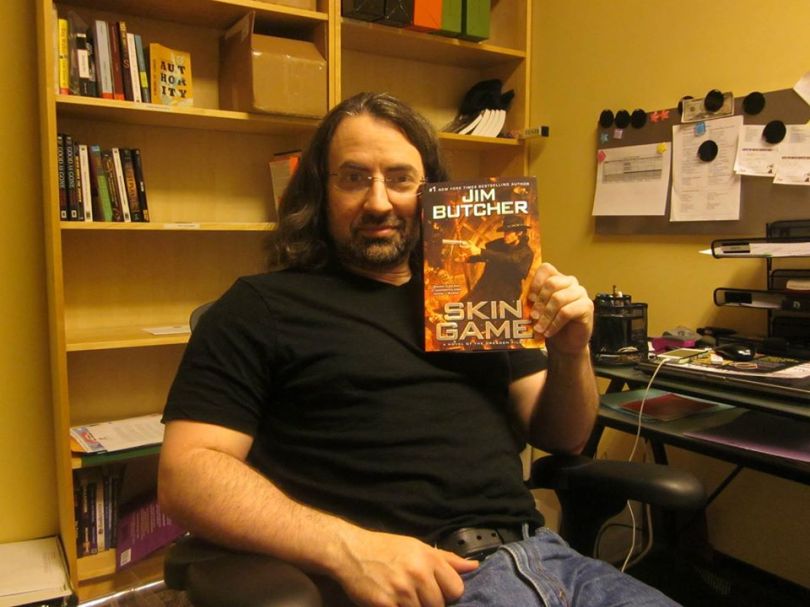
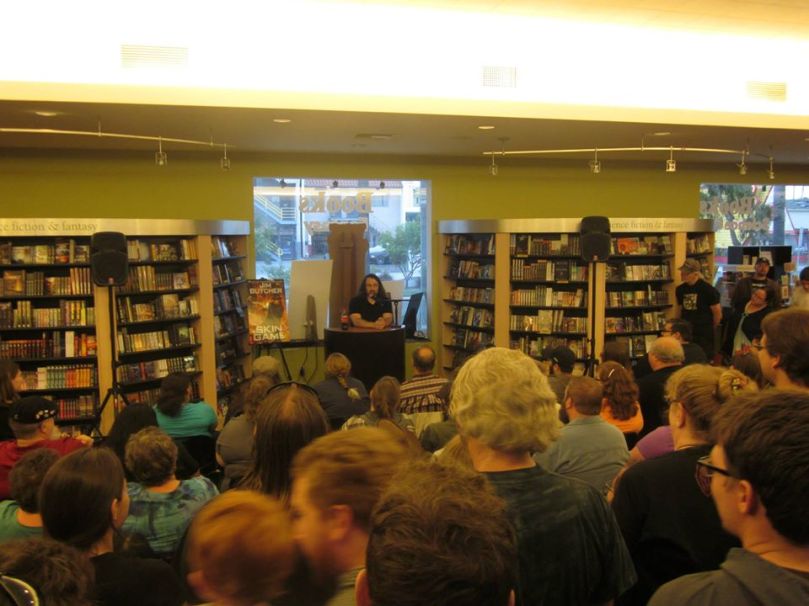
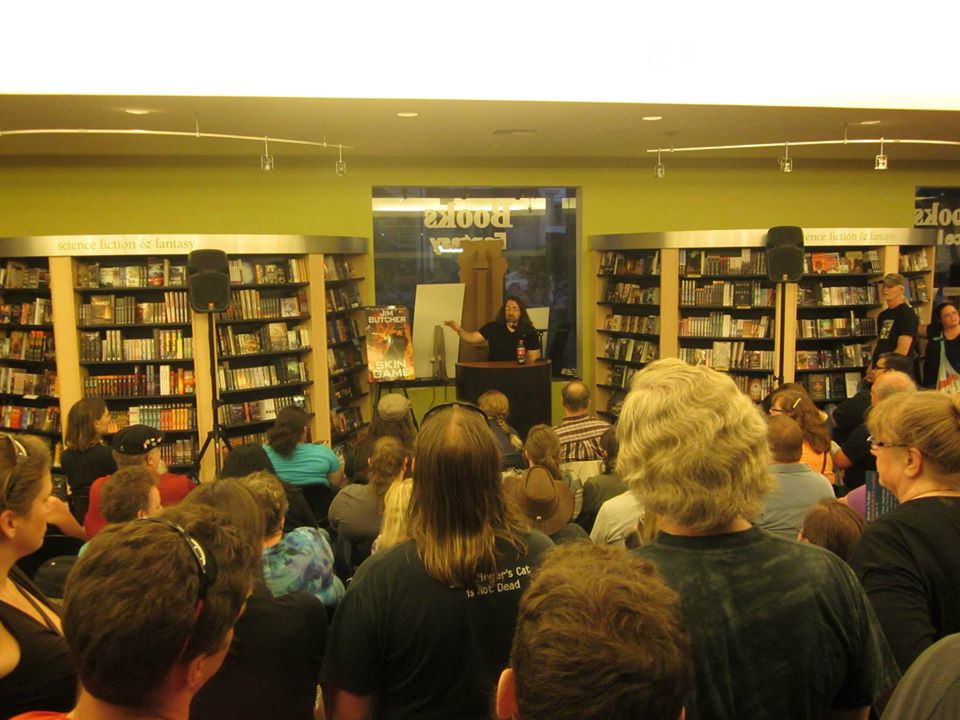
You might not have ever heard of Jim Butcher, but he came out with a book last Tuesday. Well, he came out with another book. The fifteenth, in fact, of his wildly popular urban-fantasy series, The Dresden Files. Despite not being a huge fan of urban fantasy, I found myself at the launch party for Skin Game at Mysterious Galaxy in Redondo Beach, California. While all the talk of Odin, and Bigfoots, and Wizard councils was over my head, I could glean a bit of writing advice when the breakneck Q & A went into that territory. No matter what you feel about Mr. Butcher (some love him , some do not) he had some interesting things to say about all things writing (from tips on how to make a good scene, to sharing some of his idiosyncrasies) that are totally worth listening to. Here we go!
6. He gets his most of his writing done between 2 am and 7 am.
I’ve heard from numerous writers that they like to write mornings, but I doubt they mean this early. When asked why he writes before the break of dawn, he said it’s for two reasons. First, it’s quiet. He stated that he needs it to be absolutely silent for him to write (Patrick Rothfuss has said this about his writing process, too), and, unless you’re living in a college dorm, 2 am – 7 am are pretty quiet hours.
In addition to having the world silenced for a few hours, he said it was also the only time he’s guaranteed not to be bothered by anyone or anything. While that might come off as stand-offish, he explained it like so: “it’s the only time when I don’t have to answer a phone, or someone e-mails me and says ‘hey, we need your answer on this right away.'” Being a bestselling of author of over twenty books (he has another series, too), he’s bound to have heaps of calls and e-mails getting in the way of his writing time. When one girl asked why he couldn’t write amidst all the requests for his time, he said. . .
5. His writing brain is not connected to his talking brain (or brain for anything else)
Not only does Jim Butcher need interrupted quiet when he’s writing, but he also stated that he can’t even write after having talked to people. “After I talk to someone, I can’t even get a word down for like an hour.” To him, his brain for talking to people, doing things, and his brain for creating his stories are completely separate areas. Perhaps it takes a literal removal from others for him to enter in that world of creativity, like it’s some other world, only accessible by a certain amount of time of isolation. Interesting.
4. He will totally steal any idea he thinks is cool (and thinks we all should too!)
During the Q & A, someone asked him if he’s taken any ideas he thought were cool and integrated them into his stories. Without hesitation, he said “Absolutely”. If he thinks something is cool, he will stick it in his story and, with much conviction, said he “will make it work.” He referenced Harry Dresden’s ride on a T-Rex as being one of the harder ones to work in, but he eventually got it to work. He then went on to say that famous Picasso quote: “Good artists copy, great artists steal.”

3. He has a selected team of devoted beta readers
Before he sends his books off to his editors, he will first have a group of highly-selected betas read it. Editors are of course essential to the book-writing and book-publishing process, but for first impressions, he goes to his betas. When a hopeful fan asked him what he looked for in his beta readers, Butcher responded with “complete enthusiasm for the story and product”. Editors might read every book, sure, but they might not be the people who’ll be at the bookstore at 9AM to get the next installment as soon as they can. He went on further to say that after his betas have scoured through the text, there is really nothing left to fix once he passes it off to his editors (which the editors like!).
2. How to write a kick-ass action scene
For a lot of aspiring wordsmiths, action scenes are tough ones to crack. So when a fan asked him how to make a good one, Jim Butcher told her to watch football. While we were all confused at first, he went onto say “and listen to the announcer. Their job is describe what is happening for the people who can’t see it. And if you really listen to what they’re saying, their main objective is to tell you where the ball is. And the ball, in your scene, is whatever your character is trying to do or where they’re trying to go. So, focus on your ball, and give a vague idea of what’s happening other places.”
Very insightful. In a large action scene, we might assume we have to tell everything that is happening. I mean, there’s thousands of troops battling, and a score dragons breathing fire, and a swarm of bewitched Franzia boxes flying around! However, we really only need to focus on our characters because, well, we don’t really care all that much about troop #5,678, or Orc #3,471, do we? (I care about the Franzia.)
This line of thinking reminds me of what Peter Jackson said in terms of the editing the Battle of Helm’s Deep for The Lord of the Rings: The Two Towers. Of all the versions of that battle, he noticed that the battle got boring when you weren’t focusing on one of the main characters. Sure, show a couple of nameless elves and Orcs fighting, but then GET RIGHT BACK to one of the people we care about. And what was the result? One of the coolest battles in recent cinematic remembrance!

1. Write the book you think you can just barely pull off (if you do at all)
The evening’s most inspiring quote is the one above. Shoot for the book that is just above your skill level, the one that you think you can just maybe pull off. The novel that is that crossbeam you think you’re maybe able to jump up and touch, the novel that is that 5k you think you can run, the novel that is that triple-burger and fries combo you think you can finish (after the 5k, of course. . .). He said he reaches for the top for every book he writes. “If I write books that are easy for me to write, I think that would get boring for me very quickly. I wouldn’t be into it as much, and I think the fans wouldn’t be into as much either.” You should always be striving for that next level, because, not only will you and your fans lose gusto (which is probably the most important thing to have while writing), but you will never improve your craft (which is what we’re all here to do!). Even hardcover bestsellers can keep improving, and so can we!
En conclusión
So that’s all of it, or at least all he had to share that night. Looking at his extensive bibliography, I’m sure he has a bunch more tips to tackle all certain types of scenes. Alas, these are the ones he shared with us, and now I am sharing them with you. Hopefully this helped you learn a bit more about how you write, whether you’re someone who has to type in complete silence, or one who prefers a noisy coffee shop (like Harlan Coben does!), or someone who needs ten doughnuts before they can put their fingers on the keyboard.
Until next time, keep writing! I’m going to take a break and practice that Legolas shield-move down my apartment complex’s stairs. (Keep a look-out for my subsequent medical-bills-focused Kickstarter.)
Sincerely,
Casey of Large-Book-Event-Land
PICS OF THE EVENT!
MORE GOOD READS FROM THIS SITE:
6 Ways to Motivate Yourself to Write
5/12/14
Cool Star Wars: The Rebel Assault Games
5/7/14
Saturday is California Bookstore Day
4/30/14
Party Time at WonderCon 2014
4/21/14
Party Time at the Los Angeles Times Festival of Books
4/14/14



 Casey Poma