Laulu Linnalapsien (Finnish for “songs of the castle children”) is the first full-length album from my folk metal music project Linnalapsi. It was released on Feb 17, 2010. Do to lack of equipment, the entire album (including the guitar parts) are made from midi samples. While unavailable for a couple years, it was brought back online January 10, 2014 and can be downloaded HERE.
Track Listing:
1. Aamarusko (Dawn)
2. Spears to the Sky
3. Pitkävene
4. Juhla! (Party!)
5. Fanfare of the Gods
6. Hei
7. I Drink With Trolls
8. I Forgot My Sword
9. Olut ja vapiti (Beer and Elk)
10. Battle Chaos
11. Kotia Kohti (Homeward Bound)
12. Auringonlasku (Dusk)
13. [bonus track] I Drink With Trolls – Real Guitar Version
14. [bonus track] I Forgot My Sword “LIVE”
Credits:
All music, lyrics, vocals by Casey Poma*
*Except “Olut ja Vapiti”: Lyrics co-written by Cory Daniel. Vocals also by Cory Daniel and Chris Hardwick
Cover art: Casey Poma
Cover photograph: Jonathan King
Cover band representation: (left to right) Brian Parungao, Mark Janiak, Casey Poma, Cory Daniel, Chris Hardwick
Music videos:
Four music videos were made for Laulu Linnalapsien:
***Originally posted on my old blog on October 25, 2009***
While at a thrift store one Saturday with a friend of mine, I perused the book section to see what they had in stock. I was somewhat surprised to find that they had no interesting books, since there is usually a gem or two in the unorganized shelving and random piling. Unfortunately I found no gems, but picked up two cheap-ass books. One was a “Norwegian in ten minutes a day” which is totally fucking hard as shit, and the other is a 1979 fantasy book that is nearly falling apart called “Dragonworld.”
I don’t know if I hate all fantasy, or just old fantasy (a time when everyone ripped off Tolkien and pretended like no one would notice). Normally I wouldn’t have picked up and old, yellow-paged fantasy book, but this one had pictures! I know you’re probably rolling your eyes and thinking in a dumb cave-man voice “Wow, he only got it because it had pictures,” but I like fucking pictures in fantasy books so fuck you.
Well, I went out on a limb and paid the twenty-four cents (yes, I got this book for less than a quarter) and bought it. I began to read it in the following days, and within a week, I found myself walking to school, flipping through the pages to find the next picture. This book isn’t boring, per se, but, wait, what the fuck am I saying? It is completely boring.
The story starts off with some dumbass kid flying around on some wing contraption. When the kid sees a dragon and gets killed by it (or just crashes and burns and dies), his father Jondalrun (this ugly-ass old dude) is fucking pissed. He blames Amsel, this Da-Vinci-like maker of irrelevant tools and other knick-knackery for his son’s death, for it was Amsel’s flying machine that the fucking kid stole. A Council of Elders is called to talk about the mysterious death, because Jondalrun also accuses the Simbalese (the mysterious folk to the East) of killing his son. He’s kind of a crazy bastard, but whatever. Judging from the rest of the pictures, Amsel flees and ends up in Simbala, meeting a princess and a hero and a whatever the fuck and going on adventures with dragons and all that shit.
The story seems alright enough, except for the fact that I don’t give a fuck at all about who dies or not, but it’s the description that really bogs down the story. Like with many fantasy books, this one tries to build the world within the damn book. Instead of having us learn about how the Council of Elders works during the scene itself, they give us a fucking history lesson about how it was founded, where it first took place, and all this other bullshit that is absolutely not important. Seriously. . .I DON’T NEED ALL THIS FUCKING DESCRIPTION! I don’t give a shit about what this town looks like, because I’m pretty damn sure it looks just like a medieval town. If there’s a fucking skyscraper in the town, tell me, but otherwise, just STFU.
So, in conclusion, this book is lame. It has a sequel, but it can only be read on old-ass computers. Apparently the sequel is a “choose your own adventure” type book that you read on your computer. It has “over 60 magnificent microcomputer graphics,” and will be released in the summer of 1984. . . jesus this book is old.
Although I only paid 24 cents for it. . .I still feel a little ripped off. . . I mean. . .I paid 24 CENTS for it. . . fuck. . .it kinda smells funny too. . .
***This article acts like a giant spoiler for the whole series of books. If you still want to read them, I suggest you come back and read this after you have finished. Sincerely, Rammfan518***
As you know from reading this blog (if you actually follow it), I am not a big fan of stereotypical fantasy. If you don’t know about my hate for it, it means I am angered by Dwarves who love riches and live in mountains, Elves that live in the forest and are wise, and Humans being the fantastical world’s moral-scale experiment. However, when I was aching for something to read earlier this summer, my friend let me borrow his huge omnibus of “The Dark Elf Trilogy.” I had heard about this trilogy before in 2002, because some bookworm friend of mine was reading them. I had also heard of the character Drizzt do’Urden for a couple of years, but interest in reading either the books or about the hero was absent. So, I was anxious to see what everyone (nerds) was talking about.
I ripped through “Homeland,” the first chronological Legend of Drizzt book, at an amazing speed. Something about a whole other world about Dark Elves and the inter-workings of an underground, corrupt warrior-society was intriguing. And of course, the whole question of whether Drizzt would leave his horrible homeland or not. When he did, I was elated, and ready to go on the next journey. The second book, “Exile”, dealt with Drizzt wandering the caverns of the Underdark, trying to make friends and fighting some more monsters. A scheming villain, Jarlaxle, is introduced. By the end of the book, Drizzt realizes that he must go to the surface world. In “Sojourn,” Dirzzt makes it to the surface and there, meets a few people, some new enemies, entering a whole new world of discovery.
The next book, “The Crystal Shard” was typical fantasy fare at its most basic. There was seriously no deviating from the fantasy-book formula, as Drizzt helped defeat some wizard with the help of his newly found friends, Breunor, Cattie-Brie, Regis, and Wulfgar. In “Streams of Silver”, Drizzt and his friends go and seek out Mithral Hall, the lost Dwarven city. They fight monsters and evade a new villain to the series, Artemis Entreri. In “The Halfling’s Gem,” Drizzt and his buddies have to save their friend Regis from Artemis.
The next series is called “The Legacy of the Drow,” where Drizzt’s pissed-off family search out to kill him. The first book, “The Legacy”, features Drizzt alongside Regis, Cattie-Brie, Breunor, Wulfgar, fighting against Artemis and Jarlaxle. (Although it appears Wulfar is dead by the end of the novel, we later learn in the series that he is not.) In the next book “Starless Night”, Drizzt fights alongside Regis, Cattie-Brie, and Breunor, and fight against Artemis and Jarlaxle. Then I stopped reading, and I’ll tell you why.
For me, the Legend of Drizzt started out wonderfully, then slowly started to decline. Like a sitcom that has run out of material (i.e. Simpsons), it painfully and annoyingly repeated the same conventions over and over . . . and over. What I liked about the first three books of the Legend of Drizzt series was that in each book, there was different setting, and Drizzt LEARNED things. He learned something about life, and experience, and there were situations that dealt with morality, what is right and wrong, and how we feel about said situations. He struggled with his feelings about leaving his home, fighting against a zombie-version of his father, and making friends in the new world. He told the readers how he would feel when he would be outcast by an ignorant people. The first three books dealt with the issues of prejudice, racism, internal struggle, morality, and religion.
From the Crystal Shard onwards, Drizzt drops his introspective aspects and simply becomes and action hero, fighting off monsters and defeated wayward wizards. The themes about what is right and wrong are thrown right out the window, and killing Orcs is in. It is a bit like the Matrix trilogy, in which the first film raises questions about this or that and makes you think, whereas the next two are just action movies. The Icewind Dale trilogy seemed stale; tales ridden with absolutely meaningless adventure and action scenes. No one ever died or sacrificied, and actions were hardly questioned.
As if the loss of the moral depth of the first three books wasn’t enough, The Legend of Drizzt series suffers from a serious problem. In the first three books of the series, Drizzt goes to new places, meets new people, learns from them, and ultimately bids farewell to locations and friends he has made along the way. Once we get to the Icewind Dale trilogy, we have the same characters book after book after book after book. Now, you might think “Well, yea. . .it’s a fantasy series, of course it has the same characters.” I suppose that’s correct, but they run dry after a couple books, and frankly, after that many books, I get sick of the same damn group of people going on some damn adventure that they are for sure not going to die on. So, what is the point of reading?
But what is perhaps worse that using the same morally-good characters over and over is the repeated use of two villains. I cannot tell you how much I cannot stand the two assassins known as Artemis Entreri and Jarlaxle. Jarlaxle is that scheming Drow, who always has a trick up his sleeve. Artemis Entreri is Wario to Drizzt’s Mario, a great fighter and assassin. While these characters are fine and dandy, I cannot read every fucking fight between Artemis and Drizzt. They fight in Book Five, Book Six, Book Seven, Book Eight, and Book Nine, all the while spouting off their philosophies, never really defeating each other. This can get tiring from book to book, reading about the same swordsmen duel it out and try to better each other. It might work twice, but five or more times? I don’t think so. And Jarlaxle is in the book just as common, if not more so.
Repetitive much?
I was in the book store a week or two ago, and I saw that R.A.’s latest book in the Drizzt line of novels had been released. It was called “The Ghost King” and is the third part of the Transitions trilogy. I believe it is the nineteenth book to follow Drizzt in his many adventures. In the first book of this Transitions trilogy, we have the characters of Drizzt, Breunor, Cattie-Brie, Wulfar, and other series staples. Seriously. . .should characters introduced in the fourth book of a series still be in the seventeenth? Seriously, it begins to run dry after a while. I don’t feel like reading about the same fucking group of heroes who will never die or be defeated. It’s just boring, man.


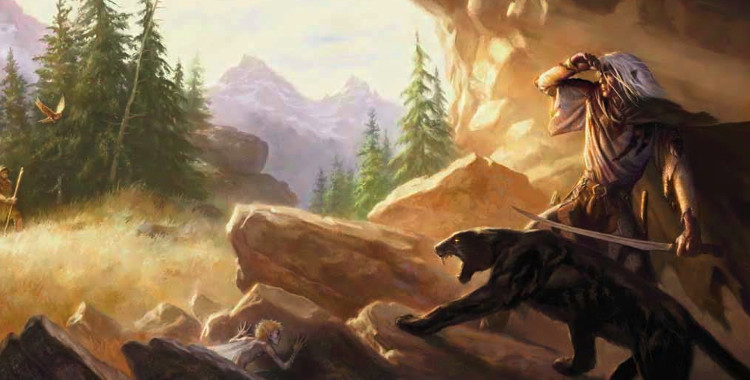


 Casey Poma