Not sure if you saw this, but a movie I co-wrote, co-directed, starred in, etc, has been finished and is on its way to the internet in just 13 short days. That’s right! You can view Cat cat Productions’s new short film, The Brat Snack, this month, on Saturday, August 20! Don’t miss the newest trailer, able to view below:
If you’re looking for some clarification, look no further! What exactly is “The Brat Snack”? And did the voiceover guy pronounce “brat” it like “braaht”, as in short for “bratwurst”? He did indeed! But going back, what is The Brat Snack? The Brat Snack is the sixth food-pun-titled movie by Cat cat Productions (Cat cat Productions is the creative collaboration between myself and filmmaker Ralph Blanchard, and the food-pun successors are Honted Dog, Apple Die, U.PH.O., Salmonrai, and Yeehawbanero). As with the past three films, a particular genre or director’s style is tackeld. U.PH.O. was our riff on the 1960’s science-fiction film, while Salmonrai was a Kurosawa-inspired action fantasy. Yeehawbanero dealt with habanero bullets and also took some time for Leone-style drawn-out epicness. The Brat Snack jumps through time to the 80’s, and clashes together John Hughes’s Pretty in Pink and The Breakfast Club, with a fair bit of sausage thrown into the mix. Instead of taking place in a normal high school, we’re at the The Sausage Arts Academy of America. And, really, why shouldn’t we be? You ever seen a film taking place at a Sausage Academy? I sure haven’t. Such is the originality you can only find at Cat cat Productions, the home of pho-powered spacecraft and talking salmon masters!
This is impossible to tell from the trailer, but I can tell you from being there through the entire process that this is our most impressive filmic feat to date. Up until now, our longest movie was 17 minutes. This runs for 15 minutes longer. This film had the longest script and was also the most complicated, edit-wise. It’s also the most expensive. A song was written exclusively for the opening of the film. Lyrics were written to online-sourced tracks, real performers on Fiverr were objected to my vocal demos. Careful consideration for the colors and look of the film was taken. Visual effects were executed and sent back and forth via WeTransfer to make shots perfect. An older computer huffed and puffed with the live rendering of the multitudinous filters. The Brat Snack had it all.
And the good news is you’ll get to see it all in under two weeks! I’ll post again when the film releases.
Thanks for reading, hang tight, and don’t forget the caraway seeds!
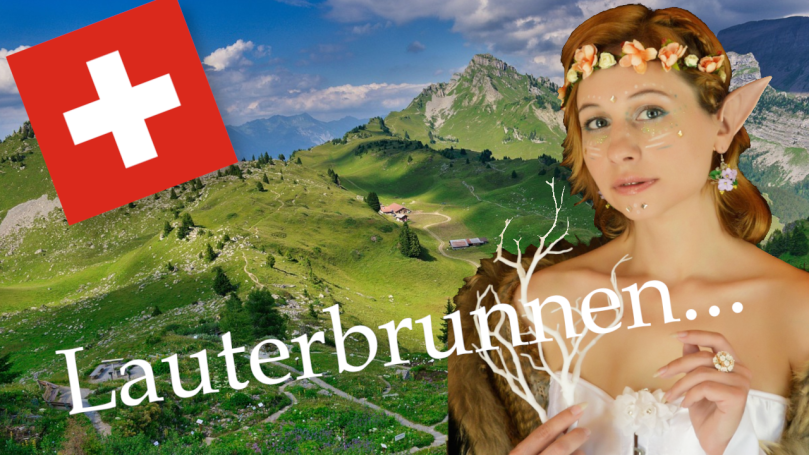
So, earlier this morning I was working on some writing/world-building and was doing some research on snowy mountain villages. I had remembered some shots of the Swiss Alpine village from the 1969 James Bond film On Her Majesty’s Secret Service, and thought I’d find out where the movie was filmed. Such googling brought me to learn that the evil-guy base in that film lies on the top of the Schilthorn, which overlooks the Lauterbrunnen valley and its collection of villages.
I had recognized this name and the image of the valley from earlier searches about the origins of Tolkien’s works. It has long been posited that Lauterbrunnen, Switzerland was the inspiration for Rivendell in Middle-Earth. He had traveled there in 1911, and wrote years later in a letter to his son Michael:
“I am… delighted that you have made the acquaintance of Switzerland, and of the very part that I once knew best and which had the deepest effect on me. The hobbit’s journey from Rivendell to the other side of the Misty Mountains, including the glissade down the slithering stones into the pine woods, is based on my adventures in 1911… Our wanderings mainly on foot in a party of 12 are not now clear in sequence, but leave many vivid pictures as clear as yesterday.”
To further drive this home, here is Tolkein’s rendition of Rivendell next to an image of Lauterbrunnen:
But just in case we needed more proof, I have some linguistics to back up this claim!
Lauterbrunnen is made up of two German words. “Laut”, which means “loud” and “brunnen”, which means “fountain”, “well”, or “spring”. So Lauterbrunnen means “loud-fountain”, “loud-well”, or “loud-spring”. I couldn’t help but notice that “brunnen” sounded an awful lot like “Bruinen”, the river that hugs right up close to Rivendell in Middle-Earth. It is in fact the fords of the River Bruinen where the Black Riders are washed away by those horse-shaped rushes of water.
As depicted here on a few paperback versions of FOTR
Going deeper, I couldn’t help but wonder what “Bruinen” meant in Tolkien’s works. Surely, it would have some sort of translation from one of his languages. After some research and reviewing the text, whattya know, “Bruinen” it means “Loudwater”. Extremely similar to the translation for “Lauterbrunnen.” What a linguistic homage!
Doing a Control+F of “Loudwater” on the text of The Fellowship of the Ring shows that it is mentioned five times in the text. Here is the clearest indication they are the same river:
“What is that other river we can see far away there?’ asked Merry.
”That is Loudwater, the Bruinen of Rivendell,” answered Strider. “The Road runs along the edge of the hills for many miles from the Bridge to the Ford of Bruinen. But I have not yet thought how we shall cross that water.”
“Nen” can be found in other water-based Middle-Earth locations, like the lakes Nen Hithoel and Sea of Núrnen? As to whether this “nen” meaning “water” came first, and it was a happy coincidence that “Brunnen” had “nen” in there already, or if that came first and Tolkien decided to use “nen” for multiple water locations, who can say? Maybe a Tolkien linguist could help me out here!
Either way, couldn’t ignore this little linguistic homage and thought I would share. Happy reading!
Here I am with another blog article! This time, I am going to wax long about two things I like, so you’ll have to deal with that. Been a while since I’ve written a blog article! I had the busiest-as-hell July, but I wanna get writing. This isn’t 2007 anymore. Nice blogs cost money now, and i’m shelling out the “hard”-earned cash for this, so I want to get my money’s worth. So I’m going to get my money’s worth by explaining why a Norwegian symphonic black metal band could and should compose music for the biggest space fantasy of all time.
So, I’ve been a primarily-listening-to-metal guy probably since about 2006. It was touch and go with punk and conscious rap there for a while, but eventually the guitars and growls won out. Maybe if there had been conscious rap about Vikings or troll sagas…who can say?! In my early years, and for much of the following, I stayed pretty close to Finnish metal, ignoring Swedish, Norwegian, and other Nordic bands. I’d heard Dimmu Borgir before, but honestly never caught onto them. I think this is mostly because I was introduced to their music through their music videos, which mostly feature them standing around, alone, in big empty spaces looking…scary? I understand metal budgets are cheap, but it doesn’t help the music to have the band members standing around like costumed amusement park haunted-house employees, fingers clenched as if holding an invisible pomegranate, grimacing into the ether.
Pure nightmare fuel!
Dimmu Borgir or Muppet?
Is he, like, laughing?
Earlier this year, my Spotify algorithm was like “please listen to something else other than these four bands and Johnny Mathis” and threw me Dimmu Borgir, and I said back “okay, fine, it has a skull on the album cover, whatever”. This time, Dimmu Borgir worked. And boy, did it work! “Gateways” was the one that got me hooked (which I always thought was a funny coincidence). In the ensuing weeks, I listened to their Abrahadbra album hella. (Don’t worry, Dimmu fans, I am slowly listening to their older, more pure black-metal stuff. Calm down).
In this immersion, I would often watch their live videos while working from home, that is, processing online orders for a bookstore (nothing reminds one of the written word more than screechy vocals and choir-laden, double-bass apocalypse!). In their career performing live, they’ve sometimes performed with a whole entire orchestra, and sometimes, the orchestra will play an orchestra-only version of their songs! I was enjoying these too, in a music-score kind of way, when it struck me. Dimmu Borgir could totally compose music for fucking Star Wars.
Now, my history with Star Wars is long and conflicted and could cover 10,000 blog articles, but the short version is: I love the old movies to death, abhor the prequels, got excited for the Disney era, loved Force Awakens, and hated everything else except Solo. I don’t watch the cartoons and Mando was like whatever. Basically, I haven’t been happy with it for a long time. In my own life head-canon, I somehow get rich enough to wrangle Star Wars from the Disney claws and can finance my own fucking Star Wars movies (or at least get license to from them). With this plan in the back of my head, I am always on the look-out for Star Wars-y music that will serve as soundtracks to these hypothetical new films (that would probably take place far after Return of the Jedi, and for the record, would be good and would not be shit).
So, all right, enough talk and set up, this isn’t a recipe! Here is why I think Dimmu Borgir could compose some fuckin’ Star Wars music.
Exhibit A: “Eradication Instincts Defined (Orchestral Version)
Doesn’t this just sound like some sweet old Star Wars music? Right off the bat, it sounds like some dark-side user and their cadre of cronies are up to no good. Can’t you just see it in your mind? Some dark lord marching along with some troopers behind them? Or perhaps, this could be the theme of a new villainous organization. I might remove the choir, since Star Wars barely had that shit, but keep the instrumentation. I just love it.
Approaching 1:50, the song’s mood changes to some urgency. High tension between the stars! For this, I can see some officers on some good-guy ship discussing some plans to deal with a nasty blow to their war strategy (or something like that). Then we get to 3:10, and something bad has happened. Oh man! Someone is tumbling to their imminent death! Or a vital ship is going down! Round back to the opening melody and you got your evildoers bein’ jerks again. Fuck yeah.
Exhibit B: The beginning of “The Serpentine Offering”
The orchestral part of this song only goes for 45 seconds, but I mean, come on. You thought there was an evil theme in the last one, well listen to this. What classic, militaristic villain music. Does it sound like “Imperial March” in the beginning? Well, yes it does, but the lead melody is different, so fuck it. Just imagine another villain coming onto the screen to this music. Delightful.
So, yes, let’s get these two together. There are other orchestra-only songs they have, but “Eradication Instincts Defined” is really the best example of their Star Wars-y-ness. What do you think? (I don’t know if I allow comments on this blog, if not, just as rhetorical, see the question!)
Wouldn’t this be cool? Come check cinemas in 25 years when this happens! If all goes according to plan, I’ll be able to independently produce Star Wars movies (Big D can keep all the money), and Dimmu would still be kicking around. Hmm..now I’m going to be thinking about these future Star Wars movies all day… Thank you for reading and may the force be with your unhallowed soul!
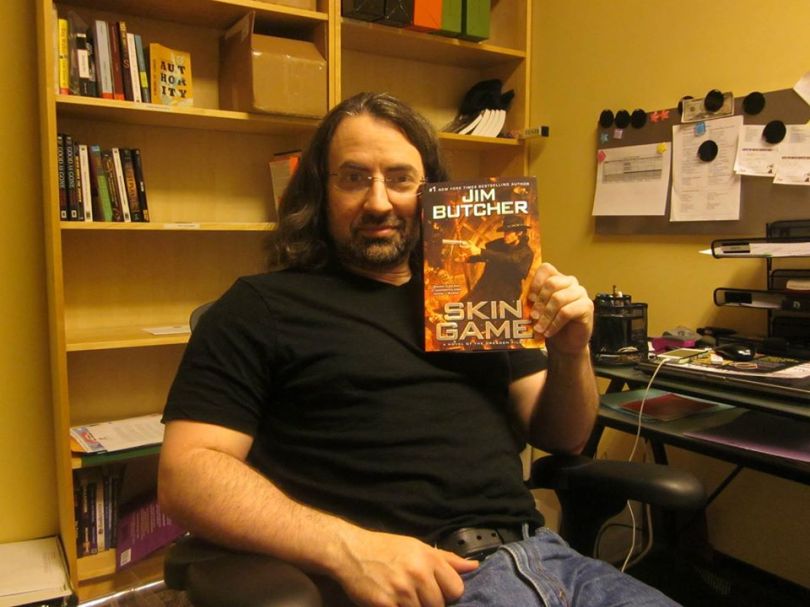
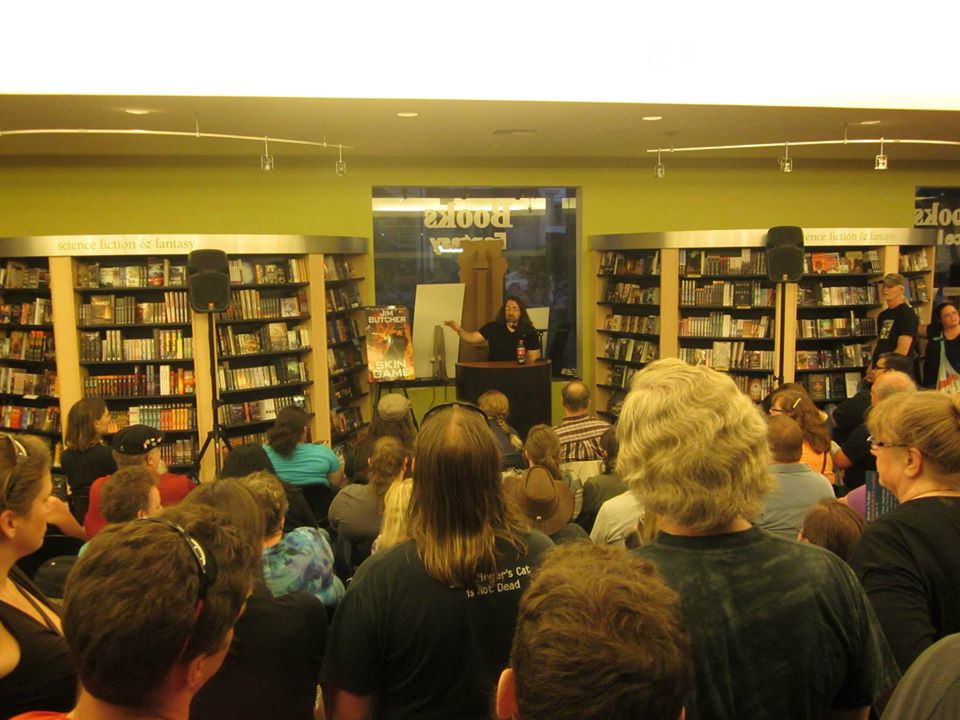
You might not have ever heard of Jim Butcher, but he came out with a book last Tuesday. Well, he came out with another book. The fifteenth, in fact, of his wildly popular urban-fantasy series, The Dresden Files. Despite not being a huge fan of urban fantasy, I found myself at the launch party for Skin Game at Mysterious Galaxy in Redondo Beach, California. While all the talk of Odin, and Bigfoots, and Wizard councils was over my head, I could glean a bit of writing advice when the breakneck Q & A went into that territory. No matter what you feel about Mr. Butcher (some love him , some do not) he had some interesting things to say about all things writing (from tips on how to make a good scene, to sharing some of his idiosyncrasies) that are totally worth listening to. Here we go!
6. He gets his most of his writing done between 2 am and 7 am.
I’ve heard from numerous writers that they like to write mornings, but I doubt they mean this early. When asked why he writes before the break of dawn, he said it’s for two reasons. First, it’s quiet. He stated that he needs it to be absolutely silent for him to write (Patrick Rothfuss has said this about his writing process, too), and, unless you’re living in a college dorm, 2 am – 7 am are pretty quiet hours.
In addition to having the world silenced for a few hours, he said it was also the only time he’s guaranteed not to be bothered by anyone or anything. While that might come off as stand-offish, he explained it like so: “it’s the only time when I don’t have to answer a phone, or someone e-mails me and says ‘hey, we need your answer on this right away.'” Being a bestselling of author of over twenty books (he has another series, too), he’s bound to have heaps of calls and e-mails getting in the way of his writing time. When one girl asked why he couldn’t write amidst all the requests for his time, he said. . .
5. His writing brain is not connected to his talking brain (or brain for anything else)
Not only does Jim Butcher need interrupted quiet when he’s writing, but he also stated that he can’t even write after having talked to people. “After I talk to someone, I can’t even get a word down for like an hour.” To him, his brain for talking to people, doing things, and his brain for creating his stories are completely separate areas. Perhaps it takes a literal removal from others for him to enter in that world of creativity, like it’s some other world, only accessible by a certain amount of time of isolation. Interesting.
4. He will totally steal any idea he thinks is cool (and thinks we all should too!)
During the Q & A, someone asked him if he’s taken any ideas he thought were cool and integrated them into his stories. Without hesitation, he said “Absolutely”. If he thinks something is cool, he will stick it in his story and, with much conviction, said he “will make it work.” He referenced Harry Dresden’s ride on a T-Rex as being one of the harder ones to work in, but he eventually got it to work. He then went on to say that famous Picasso quote: “Good artists copy, great artists steal.”
If only he’d gone into the arts. . .
3. He has a selected team of devoted beta readers
Before he sends his books off to his editors, he will first have a group of highly-selected betas read it. Editors are of course essential to the book-writing and book-publishing process, but for first impressions, he goes to his betas. When a hopeful fan asked him what he looked for in his beta readers, Butcher responded with “complete enthusiasm for the story and product”. Editors might read every book, sure, but they might not be the people who’ll be at the bookstore at 9AM to get the next installment as soon as they can. He went on further to say that after his betas have scoured through the text, there is really nothing left to fix once he passes it off to his editors (which the editors like!).
2. How to write a kick-ass action scene
For a lot of aspiring wordsmiths, action scenes are tough ones to crack. So when a fan asked him how to make a good one, Jim Butcher told her to watch football. While we were all confused at first, he went onto say “and listen to the announcer. Their job is describe what is happening for the people who can’t see it. And if you really listen to what they’re saying, their main objective is to tell you where the ball is. And the ball, in your scene, is whatever your character is trying to do or where they’re trying to go. So, focus on your ball, and give a vague idea of what’s happening other places.”
Very insightful. In a large action scene, we might assume we have to tell everything that is happening. I mean, there’s thousands of troops battling, and a score dragons breathing fire, and a swarm of bewitched Franzia boxes flying around! However, we really only need to focus on our characters because, well, we don’t really care all that much about troop #5,678, or Orc #3,471, do we? (I care about the Franzia.)
This line of thinking reminds me of what Peter Jackson said in terms of the editing the Battle of Helm’s Deep for The Lord of the Rings: The Two Towers. Of all the versions of that battle, he noticed that the battle got boring when you weren’t focusing on one of the main characters. Sure, show a couple of nameless elves and Orcs fighting, but then GET RIGHT BACK to one of the people we care about. And what was the result? One of the coolest battles in recent cinematic remembrance!
Don’t act like you don’t like it
1. Write the book you think you can just barely pull off (if you do at all)
The evening’s most inspiring quote is the one above. Shoot for the book that is just above your skill level, the one that you think you can just maybe pull off. The novel that is that crossbeam you think you’re maybe able to jump up and touch, the novel that is that 5k you think you can run, the novel that is that triple-burger and fries combo you think you can finish (after the 5k, of course. . .). He said he reaches for the top for every book he writes. “If I write books that are easy for me to write, I think that would get boring for me very quickly. I wouldn’t be into it as much, and I think the fans wouldn’t be into as much either.” You should always be striving for that next level, because, not only will you and your fans lose gusto (which is probably the most important thing to have while writing), but you will never improve your craft (which is what we’re all here to do!). Even hardcover bestsellers can keep improving, and so can we!
En conclusión
So that’s all of it, or at least all he had to share that night. Looking at his extensive bibliography, I’m sure he has a bunch more tips to tackle all certain types of scenes. Alas, these are the ones he shared with us, and now I am sharing them with you. Hopefully this helped you learn a bit more about how you write, whether you’re someone who has to type in complete silence, or one who prefers a noisy coffee shop (like Harlan Coben does!), or someone who needs ten doughnuts before they can put their fingers on the keyboard.
Until next time, keep writing! I’m going to take a break and practice that Legolas shield-move down my apartment complex’s stairs. (Keep a look-out for my subsequent medical-bills-focused Kickstarter.)
Ah, writing. Is there anything that is equally fun and nightmarish at the same time? Sometimes we love it. Other times, it’s the bane of our existence. We want to reach the top of the mountain, but the climb up was way harder than we expected.
Don’t fret. Writing a book is a monumental task, and if you ask anyone who’s ever tried, they’ve had problems with staying motivated. I’m not a published author (yet?), so I’m not really qualified to give writing advice, but I have written four novel-length things (avg. 70, 000 words) and can share with you some techniques I use to get myself WRITING. It’s all about starting, mostly, but sometimes, we need an extra push to get started. Here are six ways I have kick-started myself into getting words on the page.
Look at your bookshelf
I imagine that, wanting to be a writer, you have a bunch of books. Look at your bookshelf (or stack of books all over your floor. . .) and realize what is missing. That’s right. Your books! With us being so closely acquainted with our books and characters, it’s easy to forget that no one else has even heard of them. In our minds, they’re already out there for everyone! But they aren’t. They’re not out there in any bookstore. So remember, the only way your book is going to be out there and on a shelf someday (and hopefully, on a BUNCH of shelves all over the world) is if you get to working on it. So take one step closer to having your name among your favorites.
If you want to take this a step further (which I have), go to a bookstore and find where your books would be on the shelf. My guess is that they will be missing there, too. This simply will not do. So get cracking and you’ll be one step closer to having them there.
Set your timer for 30 minutes
In an age of constant distraction, how does anyone expect to actually sit down and write? We watch videos in six seconds, and switch our minds even less (hopefully we still have enough attention to have read this far!). So set your timer for 30 mins and just work on your novel. Lock yourself away and know that 30 mins is going to be devoted to the act of writing. It’s pretty amazing how much you can get done in an uninterrupted 30 mins. If you want to really go nuts, start doing two hour sessions. You’ll get a lot done and the two-hours of hard work will justify the nap you were going to take later anyway.
Hmm. . .nap.
Remember what Opportunity Cost is
If you ever took an economics class (and had the willpower to not sleep through it) you might remember a thing called “Opportunity Cost”. For those of you that don’t know what it is, it is essentially the cost of not doing something. For example, if I spend four hours sitting around, that sitting around session cost, according to Opportunity Cost, at an $8/hr rate, 32 dollars, because it could have been four hours that I could have been working. Since I’m guessing you want to make a living at writing, you could apply this idea to your writing schedule. Not writing your book is costing you money, because delaying writing it means you’re further away from the expenses that your book will (hopefully, someday) generate.
Make a “Productivity Contract” with someone
If you want to take the whole Opportunity Cost/Losing Money angle to a whole new level, then go ahead and make what I call a “Productivity Contract” with a friend. (Sometimes these are called Ulysses Pacts). What it is, essentially, is that you set yourself a task, and if you don’t do it by the time specified, you owe your friend 20 bucks. Opportunity Cost, sure, you might theoretically losing money, but by signing this contract, you WILL actually lose money. I’ve used these extensively for things I need to get done (mostly laundry) and the thing is, they always work. By doing what you need to do, you end up saving money and getting work done. It’s a win-win.
Think about your characters and how they want to be written about
I don’t know if you do this, but when I am feeling lazy about writing, I will often think that I am in some sort of meeting with my characters. In this type of scenario, I am a writer, hired to chronicle their crazy adventure, and they are some super-famous group of individuals. I’m the writer chosen to write their tell-all book about their exploits. Here’s the thing. They WANT you to tell their story. Your characters have been on this incredible journey and learned this incredible thing (or whatever), so they want you, their commissioned writer, to get on with and bring it to the world. Their insistence in being heard might just get you to start typing away. Remember from above: No one knows your characters yet.
Why is he not done writing my story yet? :(
Remember it is your duty to bring this book into the world
Look, ideas are crazy things. We get a million a day, all with different aspects and features (mine are mostly about food). Your book is made up of a bunch of ideas from innumerable sources, and you might be able to think that someone has thought of it all before. But the idea for your novel arrived on YOUR brain’s doorstep. It didn’t arrive at my mental doorstep, or your friend’s or Bill Clinton’s. It arrived at yours. I don’t know about you, but I think story ideas come from whatever you want to call it, the Universe, the great beyond, the weaving of the muses, etc, and what I recognize is that this story is my sole responsibility to bring to all of you. If I don’t, these characters and stories will be lost forever. And if you think someone will, in the next 100 or 1,000 years, come up with the same idea, just remember that no one already has. So don’t see it as a burden, see it as an honor. And be glad to do your duty bringing this thing to life.
What about you? What tips do you use to motivate yourself?










 Casey Poma